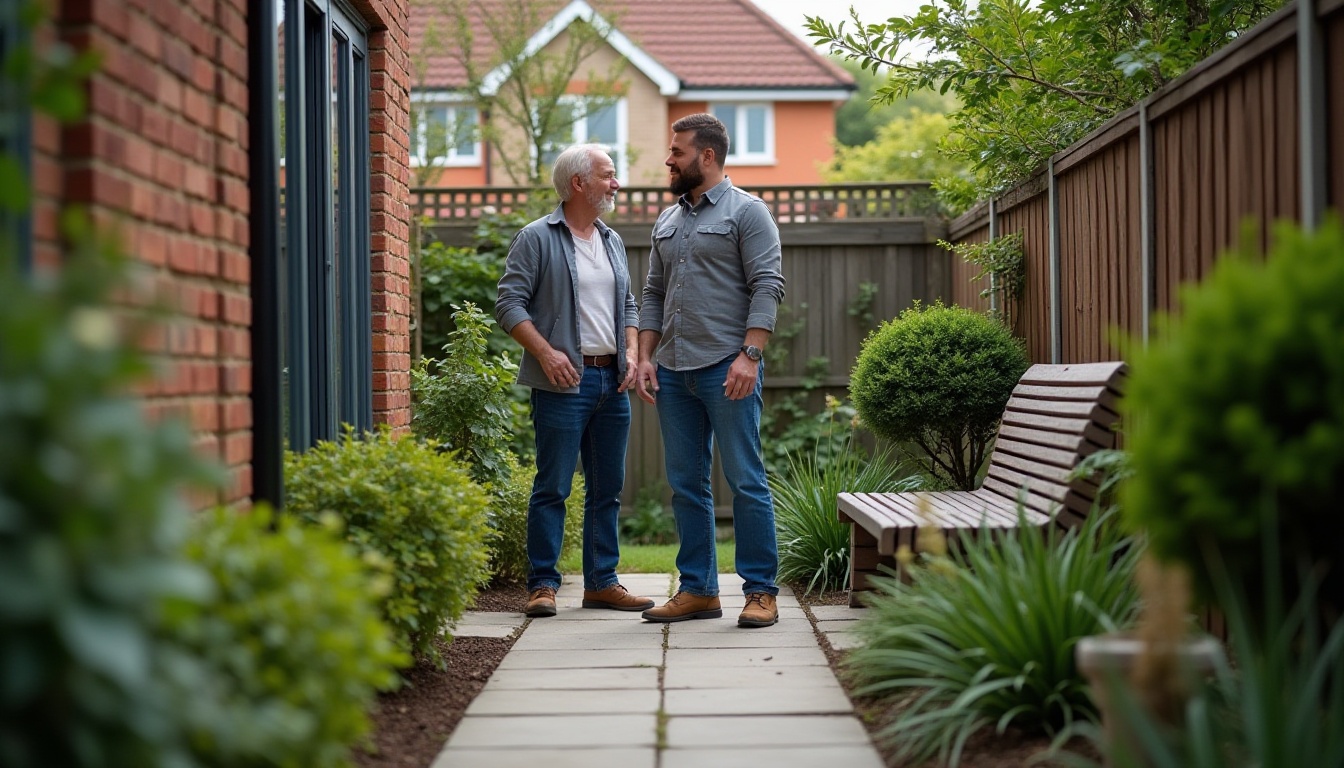
Small garden landscaping is less about squeezing in miniature versions of everything and more about deciding what deserves the available space. A compact Plymouth garden can still provide somewhere to sit, useful planting, privacy and storage, but each element needs to earn its place. Strong priorities and simple circulation usually produce a more comfortable result than filling every boundary and corner with a separate feature.
Small garden landscaping needs clear priorities
Begin by identifying the garden’s main job. For one household it may be an outdoor dining room; for another it may be a play space, a green retreat or a place to grow plants. Secondary functions can then be fitted around that primary use. If eating outside is the priority, allow enough room to move around a table rather than choosing an undersized patio merely to preserve several other features.
Measure the garden and also measure the objects you expect to use in it. Furniture, bicycles, bins and storage are often larger than they appear on a sketch. Marking dimensions temporarily on the ground can reveal whether a proposed route or seating area will feel comfortable before construction starts.
Keep circulation direct and useful
Paths consume a large proportion of a small plot, so avoid creating routes that exist only because a plan looks decorative from above. A direct path to a shed or gate can be both practical and attractive. Where a seating surface already lies on the natural route, it may perform two functions rather than requiring a separate path alongside it.
Changes of level also use space. Steps, retaining edges and ramps need room to work safely. Where levels can be simplified without creating drainage or structural problems, the garden can feel larger and become easier to move through.
Use fewer materials for a calmer result
Too many paving types, colours and edging materials can fragment a compact garden. A restrained palette usually creates a stronger sense of continuity. Repeating a material already associated with the house can help connect indoors and outdoors, while contrasting texture can be introduced through planting, gravel or timber rather than another hard-surface pattern.
Scale matters. Very large units are not automatically wrong in a small garden, and very small units are not automatically right. Ask how joints, cuts and edges will fall in the actual dimensions. A good layout should look intentional and avoid awkward narrow pieces along boundaries.
Plant vertically without creating a wall of clutter
Boundaries are valuable growing space. Climbers, wall-trained plants and carefully positioned taller planting can add greenery without taking over the centre. However, check mature size and support requirements. A vigorous climber that outgrows its space may become a larger maintenance problem than a conventional shrub.
The Royal Horticultural Society illustrates a range of approaches in its small garden design ideas. One useful principle is that a limited footprint does not require limited character; the design can still be strongly planted or highly functional if the choices are deliberate.
Choose furniture before finalising the hard landscaping
Furniture is part of the layout, not something to think about after the patio is built. Decide whether you need upright dining, informal lounging or one flexible seat. Built-in seating can sometimes use a boundary efficiently, but it is less adaptable than movable furniture. Storage benches can combine functions if they remain comfortable and weather-resistant.
Allow room to pull chairs back, open doors and reach planting. A beautiful drawing can fail in use if people must constantly move furniture to cross the garden. Ask a landscaper to show important dimensions rather than relying only on an impressionistic sketch.
Ways to make limited space work harder
- Give the garden one clear main use.
- Combine circulation and seating surfaces where practical.
- Use boundaries for planting or screening.
- Choose furniture to scale before construction.
- Keep materials and colours relatively restrained.
- Create built-in or discreet storage where it genuinely helps.
- Use planting with known mature sizes.
- Preserve some open space instead of filling every corner.
Create privacy at the places that need it
A small garden does not always need uniformly tall screening. Sit where the main seating area will be and identify the actual sightlines. A carefully placed plant, trellis or screen may block an overlooking view without enclosing the entire garden. This can preserve light and make the space feel less boxed in.
Before increasing boundary height or adding structures, check whether planning restrictions or neighbour considerations apply. Where a boundary is shared, establish ownership and discuss changes early. Planting can soften screening, but choose species that will remain manageable in the available width.
Use planting to create depth
A completely paved small garden may be easy to imagine as spacious, but planting often makes the space feel richer and more layered. Repeat a small selection of plants instead of using one of everything. Combining lower planting with a few stronger vertical forms can create depth without visual chaos.
Think about the view from inside the house as well as from the garden. In a compact plot, a well-positioned plant or focal point may be visible every day through a kitchen or living-room window. That can make a small amount of planting work much harder visually.
Do not forget drainage and practical access
Small gardens often contain a high proportion of hard surface, so consider how rainfall will move and where it can soak away safely. Retaining permeable or planted areas can be useful where site conditions allow. Avoid designing low points against the building simply to achieve a level seating surface.
Construction access may also affect the design and cost. Many compact rear gardens have narrow or internal access routes, making removal of old material and delivery of new products more labour-intensive. Tell potential contractors about access before they quote.
Storage should be integrated, not allowed to dominate
Decide what genuinely needs outdoor storage. A large shed can overwhelm a short garden, while smaller purpose-built storage may be enough for tools, cushions or bicycles. Position it where doors can open without blocking the main route and where it does not remove the best sitting position or view.
If you are planning changes, you can browse landscapers serving Plymouth and discuss designs suited to the actual dimensions and access of your garden. Ask for ideas that solve your priorities rather than simply adding fashionable features.
Leave some breathing space
Small garden landscaping is successful when the space feels intentional rather than full. A clear area of paving, lawn or gravel can provide visual rest between planting and furniture. That open space is not wasted; it allows the features you have chosen to be seen and used properly.
For this reason, small garden landscaping benefits from testing dimensions and priorities before materials are ordered: minor layout decisions have a large effect when there is little spare space.
With careful priorities, restrained materials, correctly scaled furniture and planting that earns its place, a limited garden can perform surprisingly well. The aim is not to make it pretend to be large, but to make every square metre useful, comfortable and attractive.