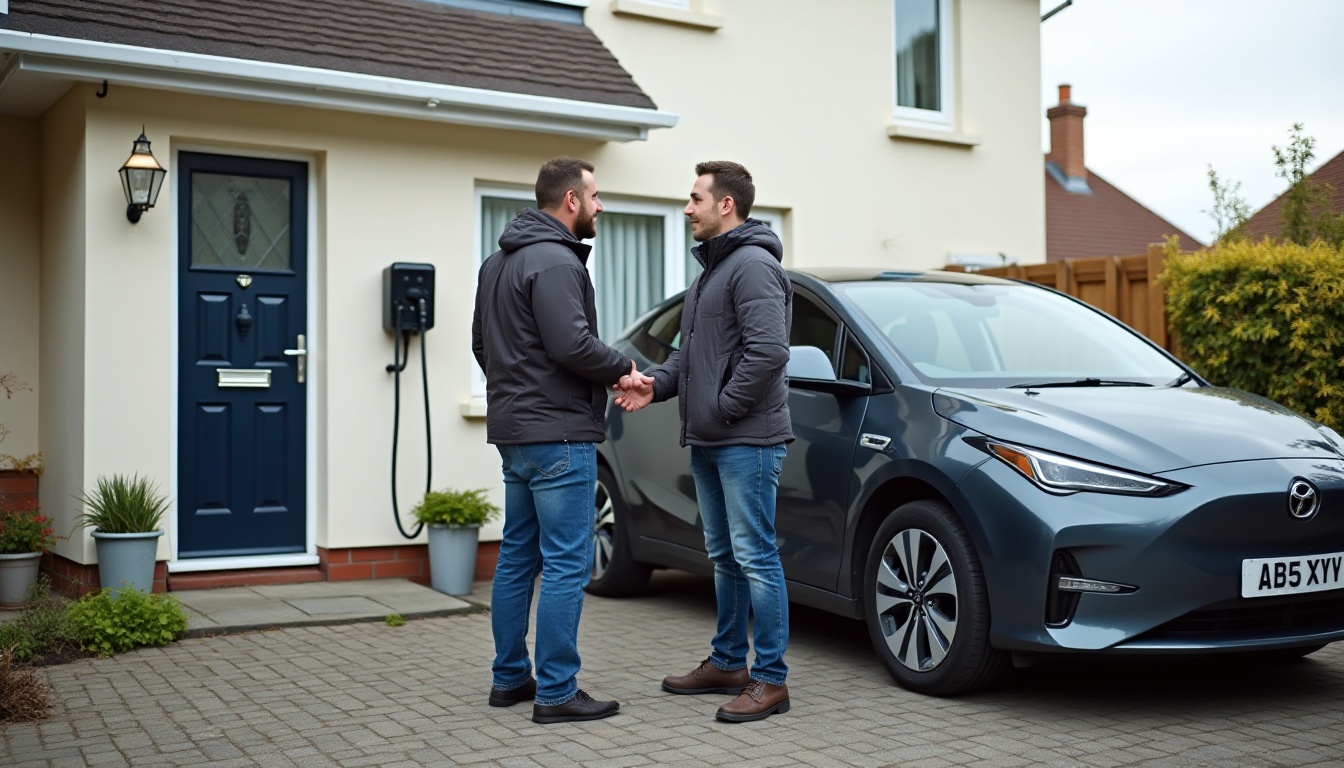
A home EV charger is easiest to plan when you think about the property, parking position and electricity supply before choosing the hardware. The wall unit is only one part of the installation. The electrician may need to consider where the vehicle normally sits, how charging will be used, the existing electrical installation, network requirements and the route to the proposed charger position.
If you want local quotations, you can browse electricians serving Plymouth and ask whether they regularly install domestic EV chargepoints and can explain the survey and notification process.
Home EV charger planning starts with the parking space
Look at where the car is actually parked, not where it happens to be standing on the day of the survey. Think about different vehicles, visitors, gates, shared access, reversing direction and whether a future EV might have its charge port in another place.
A good charger position should allow normal use without creating avoidable trip hazards or forcing awkward parking. Where parking is shared, leased or separated from the house, additional permissions or design issues may arise.
Do you have the right to install equipment there?
For a house with private off-street parking, ownership may be straightforward. Flats, rented homes, shared driveways and leasehold properties can be different. Before paying for design work, check whether you need permission from a landlord, freeholder, management company or other property owner.
Planning permission is not the only possible consideration. Physical ownership, lease terms and rights over shared areas can matter even where planning rules are not the obstacle.
The existing electrical installation needs assessment
An EV can represent a sustained electrical load for long periods. The electrician needs enough information to determine whether the existing supply, consumer unit, earthing arrangements and protective measures are suitable for the proposed installation.
Do not assume that a recently fitted consumer unit automatically means the property is ready. Equally, an older installation does not automatically mean a charger cannot be installed. The assessment should be based on the actual condition and design.
Smart-chargepoint rules affect equipment sold for private use
The UK has specific rules for many private EV chargepoints. GOV.UK explains that the Electric Vehicles (Smart Charge Points) Regulations 2021 require relevant chargepoints to provide smart functionality and meet device-level requirements. The current GOV.UK smart chargepoint guidance is the right place to check the regulatory detail rather than relying on old product reviews.
That means choosing a home EV charger is not just a styling decision. Make sure the product being supplied is appropriate for the UK market and ask who is responsible for setup, connectivity and any app account needed for normal operation.
Network notification or permission may be involved
EV chargepoint installations can interact with the local electricity distribution network. Depending on the installation and supply characteristics, the installer may need to notify the distribution network operator or obtain permission before connection.
You do not necessarily need to manage this yourself. Ask the electrician whether network paperwork is included in the quotation, whether any upgrade could be required and what happens if the network response changes the planned design.
Think about charging behaviour, not only maximum speed
A high headline charging rate is not automatically the best answer for every home. Consider how far you normally drive, how long the vehicle is parked overnight, whether you have an off-peak electricity tariff and whether more than one EV may eventually use the property.
Smart scheduling can allow charging at selected times, but the exact capabilities depend on the chargepoint, vehicle and energy arrangement. Ask what the proposed product can do without assuming every feature is universal.
Solar panels and batteries can affect the conversation
If you already have solar PV, battery storage or other on-site generation, tell the installer. Some households want to coordinate EV charging with surplus generation or broader energy management. Whether that is worthwhile depends on the equipment and household pattern.
If solar or a battery may be added later, mention that too. Sensible planning can avoid choosing a location or control arrangement that makes future integration unnecessarily awkward.
Questions to ask during the survey
- Is the proposed charger position practical for my current and likely future vehicles?
- Is the existing electrical installation suitable, or is remedial work needed first?
- What charging rate is being proposed and why?
- Does the quoted product meet the current smart-chargepoint rules that apply to it?
- Who handles any distribution-network notification or application?
- What happens if the network requires additional work?
- Is commissioning and app setup included?
- What electrical and Building Regulations documentation will I receive?
- What warranty applies to the equipment and installation?
Plan the physical location carefully
A home EV charger should be located with everyday use in mind. Consider weather exposure, accidental impact, access for other household members and whether the charger or vehicle connection would obstruct a pathway.
For Plymouth properties exposed to coastal weather, the installer should select equipment and a location suitable for the actual environment rather than assuming all exterior positions are equivalent. You do not need to specify technical enclosure ratings yourself; simply make sure the environmental conditions are part of the survey.
What about a standard three-pin socket?
Some vehicle manufacturers provide portable charging equipment for specified uses, but a dedicated chargepoint is designed for regular EV charging and can provide features and protective arrangements intended for that purpose. Follow the vehicle and charging-equipment manufacturer’s instructions and ask an electrician if you are unsure whether an existing socket is suitable for the intended use.
Do not run improvised extension arrangements across pavements, through windows or over areas where they can be damaged.
Before installation day
Confirm where the vehicle will be parked, clear reasonable access to the consumer unit and planned work area, and make sure anyone who needs to approve the installation has done so. Ask whether power will be interrupted and whether the electrician needs access to internet or Wi-Fi information for commissioning.
If a trench, post, parking alteration or other building work is needed, agree who is supplying it and whether it must be completed before the electrician arrives.
After the charger is commissioned
Ask for a demonstration of normal charging, scheduling, isolation and fault reporting. Keep the electrical paperwork, product details and any network correspondence together. If an app is used, make sure the household knows which account controls the charger.
A well-planned home EV charger should suit the parking arrangement and electrical installation rather than forcing the household to adapt around a poorly chosen position. A proper survey before purchase is often the simplest way to avoid that mistake.