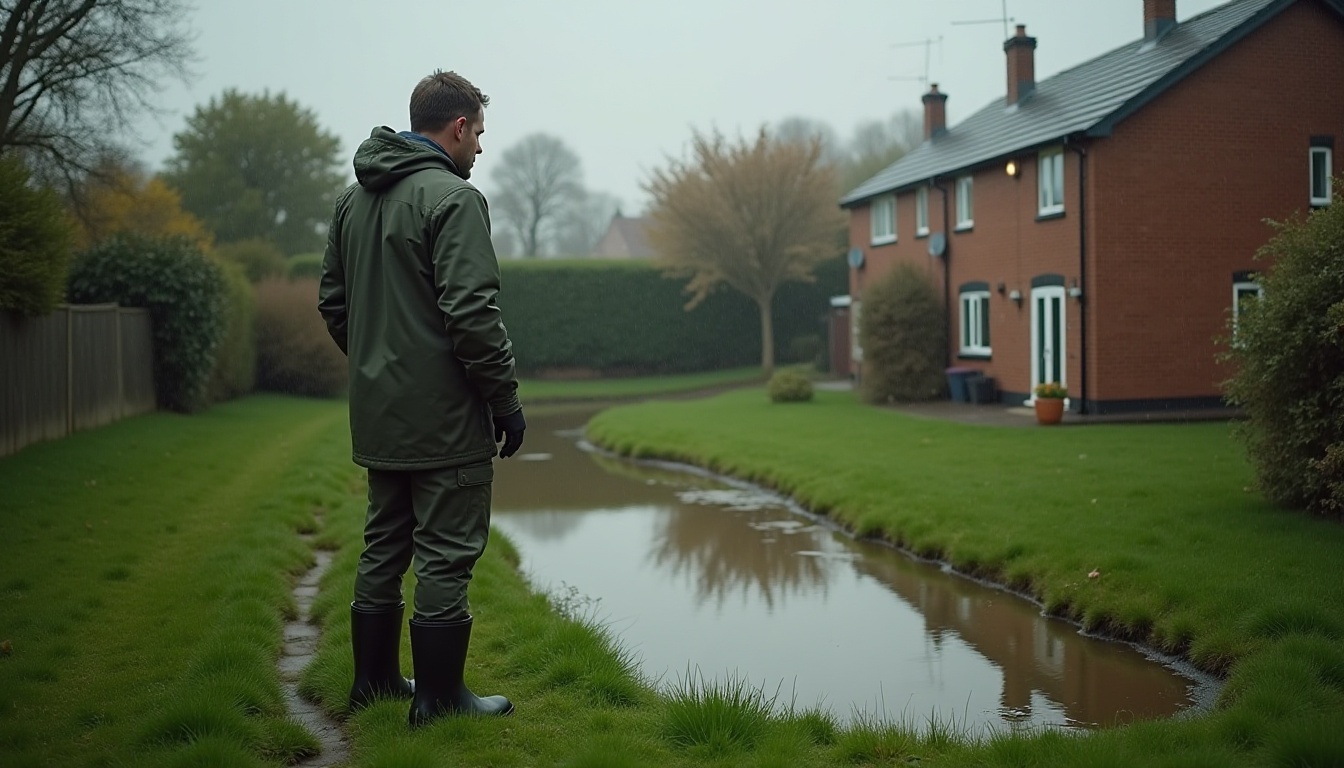
Garden drainage problems are not always obvious from a single wet day. After prolonged or heavy rain, temporary puddles can occur even in otherwise workable ground. The more useful question is how long water remains, where it repeatedly collects and whether the wet conditions are affecting lawns, paths, planting or use of the garden. Careful observation before altering the site can help distinguish a local surface issue from a wider problem that needs professional investigation.
Common signs of garden drainage problems
Persistent puddling in the same places is the most visible warning sign, but it is not the only one. Lawns may feel soft for long periods, develop worn muddy routes or become difficult to mow. Plants that dislike wet conditions can lose vigour, while some areas may remain bare because roots struggle in saturated soil. Water may also collect against paving edges or at the bottom of steps where levels concentrate runoff.
Look at timing as well as appearance. A shallow puddle that disappears soon after a storm is different from ground that stays saturated for days. The Royal Horticultural Society explains that waterlogging reduces the air available around roots and that heavy rainfall, soil conditions and compaction can all contribute. Its guidance on installing garden drainage also stresses that not every wet garden needs a drainage system and that the destination for surplus water must be considered.
Watch what happens while it is raining
If it is safe to do so, observe the garden during rainfall rather than only afterwards. Note where water arrives from, how it crosses hard surfaces and which low points fill first. Water could be falling directly onto the area, running from a higher part of the garden or being concentrated by paving. A simple sketch showing the house, paths, patio, lawn and obvious flow directions can be surprisingly useful when discussing the problem with a landscaper.
Do not assume that all water visible near a boundary originates from a neighbour, or that all wet ground is caused by rain. Unusual isolated wet patches can have other causes. Where a leak or damaged service is suspected, the appropriate utility or specialist may need to investigate. Landscaping should not be used to hide an unresolved source.
Soil compaction can mimic a drainage failure
Construction traffic, repeated walking and previous landscaping can compress soil so that rainfall enters it slowly. This is common on well-used routes and places where machinery or stored materials have loaded the ground. In some gardens, improving the soil structure and avoiding further compaction may be more appropriate than installing dedicated drainage.
The soil itself also matters. Different soils hold and release water differently, and local conditions can vary from one property to the next. Avoid broad assumptions about every garden in Plymouth. A contractor should assess the actual site, existing levels and soil behaviour rather than applying a standard solution because it worked elsewhere.
Hard landscaping changes how rainwater moves
Replacing planted ground or lawn with a larger impermeable surface reduces the area through which rain can soak naturally into the soil. It can also concentrate runoff at edges. Any new patio, path or other hard surface should therefore be considered as part of the drainage picture. Falls should send water to an appropriate place rather than toward the house or an unsuitable neighbouring area.
Permeable materials and planted areas can sometimes help manage rainfall, depending on the site. The right approach depends on ground conditions, levels and where water can safely go. Simply creating a lower point elsewhere in the garden moves the symptom rather than solving the underlying problem.
Do not choose a drainage feature before understanding the cause
It is tempting to begin with a named solution, but garden drainage problems can have different causes and constraints. Before excavation, ask what evidence supports the proposed approach and where water will ultimately discharge or infiltrate. If a proposal depends on soakage, the ground must actually be suitable for infiltration. If it relies on another outlet, the legality and practicality of that outlet need to be established.
The RHS notes that garden drainage installation is disruptive and should only be considered where needed and where surplus water has somewhere appropriate to go. This is a useful reminder that a trench or buried system is not automatically a cure for wet ground.
Information to gather before requesting quotations
- Photographs during and after rainfall.
- How long standing water normally remains.
- Whether the problem is seasonal or recent.
- Areas where plants or turf repeatedly struggle.
- Recent paving, building or landscaping changes.
- Known changes to ground levels.
- Any unusual isolated wet patches.
- How water currently leaves roofs and hard surfaces, without disturbing any system yourself.
When a landscaper can help
A landscaper can assess site levels, soil condition, surface falls, hard-landscaping layout and options such as regrading, improving ground, creating suitable planted areas or incorporating drainage measures. For complex problems they may recommend another specialist. Ask what investigation is included before accepting a quotation and whether the proposal addresses the source of the problem or only the visible puddling.
If you are seeking local help, you can browse landscapers serving Plymouth and contact businesses directly about their experience with wet gardens and drainage-related landscaping. Explain when the problem occurs and provide photographs where possible.
Protect planting while the problem is being assessed
Avoid repeatedly walking or moving machinery over saturated soil because this can worsen compaction and damage the soil structure. Where plants are suffering, appropriate species selection may sometimes be part of the long-term solution. The goal is not necessarily to make every part of a garden equally dry; it is to create conditions suitable for the intended use and planting.
Raised planting areas can be useful in some wet sites, while other gardens may benefit from choosing plants that tolerate moisture. These are design responses rather than substitutes for dealing with water that is threatening a building or caused by a fault.
Take persistent water seriously without jumping to conclusions
The best first step with garden drainage problems is evidence. Observe the site through different weather, note changes after previous work and identify where water appears to travel. Then discuss those observations with a suitable professional. A measured diagnosis is more valuable than immediately choosing a drainage product or assuming that one method will suit every Plymouth garden.
Once the cause and constraints are understood, the landscaping can be planned around sensible levels, appropriate surfaces, soil condition and a clear destination for rainfall. That approach is more likely to produce a garden that remains usable and supports healthy planting over the longer term.